

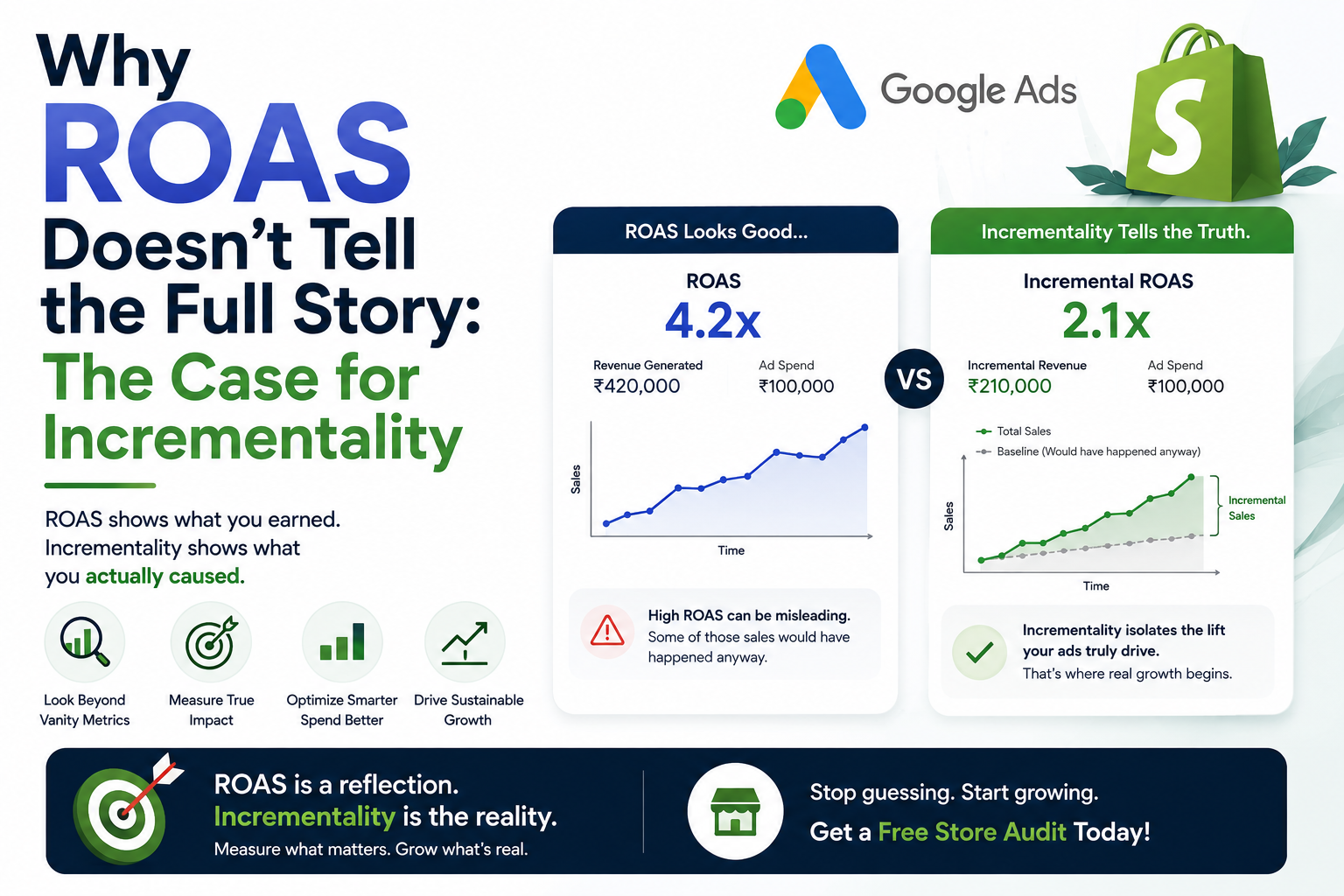
A campaign reporting 4x ROAS looks like a win. But that number only tells you how much revenue is credited to an ad, not how much revenue the ad actually caused. Those are two different questions, and confusing them is one of the most expensive mistakes a D2C brand can make with its media budget.
What ROAS Actually Measures
Return on ad spend divides revenue attributed to a campaign by the amount spent on it. The math is simple. The problem is the input: "revenue attributed" depends entirely on whatever attribution model the ad platform is using, and every platform is structurally biased toward taking credit.
If a customer already intended to buy, because they follow the brand, got a referral, or searched the brand name directly, and an ad happened to appear somewhere in that journey, the platform will still claim the sale. ROAS can't tell the difference between an ad that persuaded someone and an ad that simply intercepted a sale that was going to happen anyway.
The Gap Between Attributed and Incremental
This is where incrementality comes in. An incremental conversion is a sale that would not have happened without the ad. An attributed conversion is a sale the platform decided to credit to the ad, based on its own tracking logic — clicks, view-throughs, modeled conversions, and cross-device guesses included.
The two numbers are rarely close. We've broken down exactly how these figures diverge and why the gap matters in Incremental vs Attributed Conversions in Google Ads: What's the Difference?, which is worth reading alongside this piece if you want the mechanics behind the definitions.
A brand can run a campaign showing strong attributed conversions and healthy ROAS while the true incremental lift is a fraction of what's reported. Retargeting is the classic offender: it often shows the best ROAS in the account because it targets people who were already close to buying, not because the ads are doing persuasive work.
Why This Matters More at Scale
For a small brand spending a modest amount on ads, the gap between attributed and incremental sales might not change the business decision. But as budgets grow, brand awareness compounds, and organic and direct traffic increase, more and more "ad-driven" sales would have happened anyway. Scaling spend based on ROAS alone means pouring more money into campaigns that are capturing existing demand rather than creating new demand, and the dashboard keeps looking healthy the whole time.
This is exactly the scenario we walk through in What Incrementality Means in Google Ads and Why It Matters: a campaign can report 100 attributed sales while the true number caused by the ad is meaningfully lower, and the only way to know the real figure is to test for it.
How to Actually Test for Incrementality
Incrementality isn't a report you pull — it's an experiment you run. The standard approaches:
- Geo holdouts: pause or reduce spend in a set of matched regions while running normally elsewhere, then compare sales lift.
- PSA / ghost ads: platforms like Meta serve a public service ad instead of your creative to a holdout group, letting you compare converters against a true control.
- Conversion lift studies: built into Google Ads and Meta Ads Manager, these randomly assign users to test and control groups to isolate causal lift.
- Brand search suppression tests: temporarily pausing brand campaigns to see how much of that "purchase intent" traffic simply shifts to organic.
None of these require exotic tooling. They require patience, a large enough sample, and a willingness to accept an answer that might be lower than what the ROAS dashboard has been showing. We cover the practical checks for this in How to Check Whether Your Ads Are Actually Driving New Sales, including how to size a holdout test without starving a live campaign.
Using Incrementality Without Abandoning ROAS
The point isn't to throw out ROAS — it's still a fast, cheap signal for day-to-day optimization. The point is to stop treating it as ground truth for budget decisions. A practical framework:
- Use ROAS for daily and weekly optimization — it's directionally useful and immediate.
- Run a quarterly incrementality test on your largest spend categories, especially retargeting and brand search.
- Apply an incrementality discount to platform-reported ROAS for planning purposes, based on what your tests actually show.
- Reallocate budget toward channels and campaigns with the highest incremental return, not just the highest attributed return.
Brands that make this shift usually find the same pattern: prospecting and upper-funnel campaigns look worse on ROAS but often carry more true incrementality than the retargeting campaigns that dominate the dashboard. Rebalancing toward that reality is uncomfortable in the short term and considerably more profitable in the long term.
The Bottom Line
ROAS answers "how much revenue is credited to this campaign." Incrementality answers "how much revenue this campaign actually created." Only one of those questions should drive how a growing D2C brand allocates its next ad dollar. If your reporting stops at ROAS, you're optimizing for the platform's version of the story rather than your business's actual growth.
Related reading: What Incrementality Means in Google Ads and Why It Matters · Incremental vs Attributed Conversions in Google Ads · How to Check Whether Your Ads Are Actually Driving New Sales