

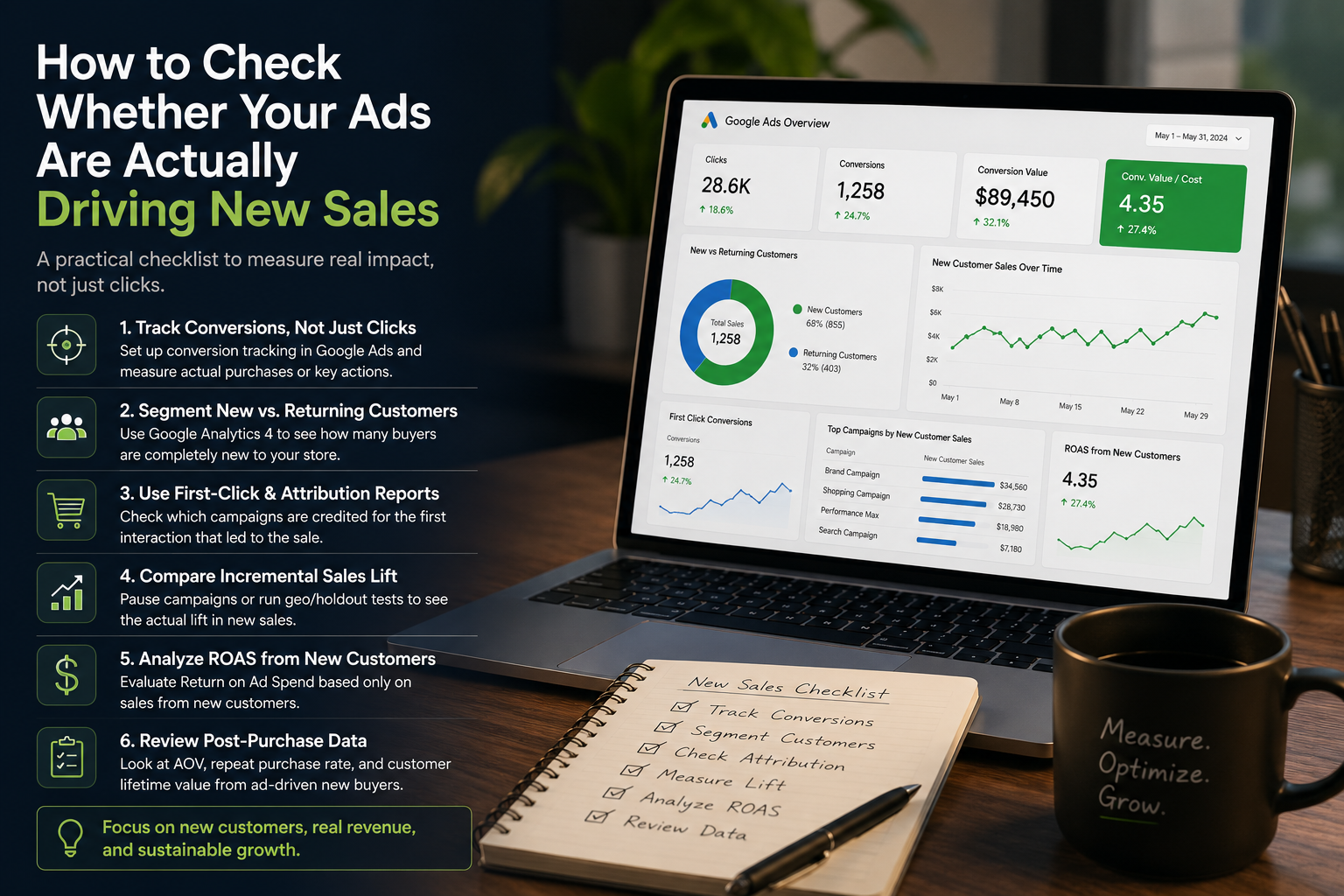
Running Google Ads can bring in more clicks, orders, and revenue. But there’s an important question many businesses overlook: Would those customers have purchased anyway?
That’s where ad incrementality comes in. Instead of simply asking how many sales your ads received credit for, incrementality asks a more useful question: How many additional sales happened because of your advertising?
Why Ad-Attributed Sales Can Be Misleading
Google Ads reports can make a campaign look successful at first glance. You may see conversions, revenue, and a healthy return on ad spend (ROAS).
But attribution doesn’t always mean causation.
For example, someone may search for your brand, click your ad, and purchase immediately. Google Ads may count that as an ad-driven conversion. But if that customer already intended to buy, the ad may not have created a new sale. They simply used the ad as one of the paths to purchase.
This is why looking at ROAS alone can give you an incomplete picture.
Also Read: What Incrementality Means in Google Ads and Why It Matters
Start With Incrementality
Incrementality measures the extra sales generated by advertising that would not have happened without the ads.
The basic idea is simple. Compare what happens when one group of potential customers is exposed to your ads with what happens when a similar group isn't.
For example:
- Group A sees your ads.
- Group B doesn't see your ads.
- Both groups are otherwise as similar as possible.
- You compare their purchase rates.
If Group A generates significantly more sales, the difference gives you a better indication of your ads' incremental impact.
Use Experiments Instead of Guesswork
One of the strongest ways to measure incrementality is through controlled experiments.
Google Ads offers testing approaches that can help advertisers compare outcomes between exposed and control groups. Depending on your campaign type and account setup, you may be able to run experiments designed to estimate whether advertising actually caused additional conversions.
The important part is having a proper comparison. Simply comparing this month's sales with last month's sales doesn't tell you what would have happened without advertising.
Sales can change because of seasonality, pricing, promotions, competitors, holidays, or changes in consumer demand.
Look Beyond ROAS
ROAS is useful, but it shouldn't be your only performance metric.
Suppose your campaign generates ₹5 lakh in attributed revenue from ₹1 lakh in ad spend. That gives you a 5x ROAS.
Sounds great.
But what if ₹4 lakh of those sales would have happened without the ads?
Your actual incremental revenue could be much lower than the platform-reported revenue.
That doesn't automatically mean the campaign is bad. Brand protection, visibility, remarketing, and customer journeys can still have value. The point is to understand what your advertising is really contributing.
Check New Customers Separately
For many eCommerce businesses, the most valuable question isn't simply "How many conversions did we get?"
It's "How many new customers did our ads help us acquire?"
Separate new customers from existing customers wherever possible. Look at first-time purchases, customer acquisition cost (CAC), repeat purchase behavior, and lifetime value.
This gives you a clearer picture of whether your advertising is expanding your customer base or mainly capturing people who were already familiar with your brand.
Test, Learn, and Reallocate Your Budget
Incrementality isn't a one-time exercise. Customer behavior and campaign performance change over time.
Test different campaign types, audiences, locations, and levels of ad exposure. Then use the results to decide where your budget is genuinely creating additional demand.
If one campaign has a lower reported ROAS but generates substantially more incremental customers, it may actually be more valuable than a campaign with impressive attribution numbers.
The Bottom Line
The best Google Ads strategy isn't about getting the biggest number in your dashboard. It's about understanding which advertising activity is actually creating additional business.
Use attribution reports to understand where conversions are being credited, but use experiments, control groups, new-customer data, and incremental revenue to understand whether your ads are truly driving new sales.
For Shopify and eCommerce brands, this shift from "What did Google Ads get credit for?" to "What did Google Ads actually cause?" can lead to much smarter budget decisions and stronger long-term growth.