

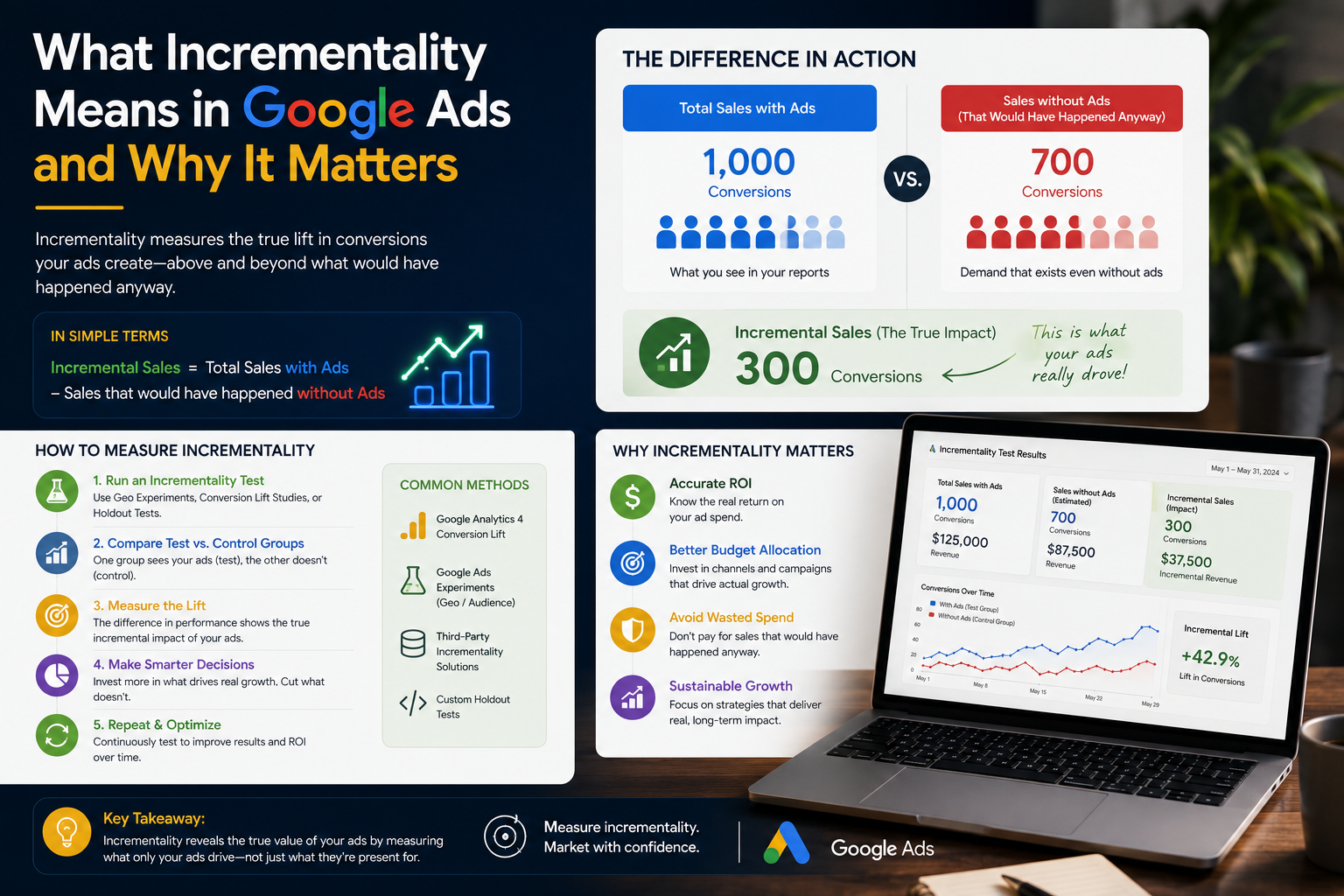
If your Google Ads report says a campaign generated 100 sales, it is tempting to assume that all 100 happened because of your ads. But what if some of those customers would have purchased anyway?
That is where incrementality in Google Ads comes in. Instead of asking, “How many conversions did my ads get?”, incrementality asks a more useful question: “How many additional conversions happened because of my ads?”
For eCommerce brands, especially Shopify stores investing heavily in paid advertising, this distinction can make a big difference.
Also Read: Incremental vs Attributed Conversion
What does incrementality mean?
Incrementality measures the extra results caused by advertising.
Imagine you stop running ads for a particular group of customers and they generate 50 sales organically. Another similar group sees your ads and generates 70 sales.
The difference—20 additional sales—is a simple way to think about incremental conversions.
So, rather than giving all credit to advertising, incrementality tries to separate sales that would have happened anyway from sales that happened because advertising influenced the customer.
This gives you a much clearer picture of whether your Google Ads budget is actually creating new demand.
Why attribution alone can be misleading
Most advertisers are familiar with conversion tracking and attribution. These tools help show which ads, campaigns, or channels received credit for a conversion.
The problem is that receiving credit does not necessarily mean causing the sale.
For example, someone may search for your brand on Google, click your branded ad, and complete a purchase. Google Ads may report that conversion, but the customer may already have decided to buy before clicking the ad.
If you only look at reported conversions and ROAS, the campaign might appear extremely successful.
Incrementality makes you look deeper.
It helps answer whether your advertising is creating additional business or simply capturing demand that already existed.
How is incrementality measured?
There isn't one single method that works for every business. One common approach is to compare customers who were exposed to advertising with a similar group that wasn't.
This is often done through controlled experiments or lift studies.
The basic idea is straightforward:
Ad-exposed group → How many conversions happened?
Control group → How many conversions happened without the ad exposure?
The difference provides an estimate of the advertising's incremental impact.
Google and other advertising platforms can use experimentation and measurement approaches to help advertisers understand this impact, although the exact method depends on the campaign, objective, audience, and available data.
Why Shopify brands should care
For Shopify and eCommerce businesses, incrementality can be especially useful when deciding where to put the next rupee or dollar of your marketing budget.
Suppose two campaigns both report a 5X ROAS.
At first glance, they look equally good.
But after deeper analysis, you discover that Campaign A is generating genuinely additional purchases, while Campaign B is mostly reaching customers who were already likely to buy.
Suddenly, the two campaigns don't look equally valuable.
This can help you make smarter decisions about Google Ads budgets, branded search, remarketing, Performance Max, prospecting, and customer acquisition.
Incrementality vs. ROAS
ROAS tells you how much revenue was attributed to your advertising spend.
Incrementality asks how much of that revenue was actually caused by the advertising.
You don't necessarily need to choose one over the other. In fact, using both can give you a better picture.
ROAS: “What revenue did the campaign receive credit for?”
Incrementality: “What additional revenue did the campaign actually generate?”
That second question is particularly important when advertising costs are increasing and every marketing dollar needs to work harder.
What should advertisers do next?
Start by looking beyond the conversion column in your Google Ads account.
Ask yourself:
- Are customers discovering us because of ads, or were they already looking for us?
- Are branded campaigns creating new demand or capturing existing demand?
- Does remarketing generate genuinely additional purchases?
- Which campaigns bring in new customers?
- What happens when advertising exposure is reduced?
- Are we measuring business growth, or simply attributing existing demand?
You don't need to run a complicated experiment for every campaign. But developing an incrementality mindset can change how you evaluate advertising performance.
The bigger picture
Google Ads reporting is useful, but no single metric tells the entire story.
Conversions, ROAS, customer acquisition cost, profit, new customers, and incrementality all answer different questions. Looking at them together gives you a more realistic view of what your advertising is actually doing.
For Shopify brands, that means moving beyond “How many sales did Google Ads report?” and asking the more important question:
“How many sales would we have missed without Google Ads?”
That is the real value of understanding incrementality.
If you're unsure whether your current Google Ads campaigns are generating new demand or simply capturing customers who were already ready to buy, a campaign and store audit can help identify where your budget is creating the most value.