

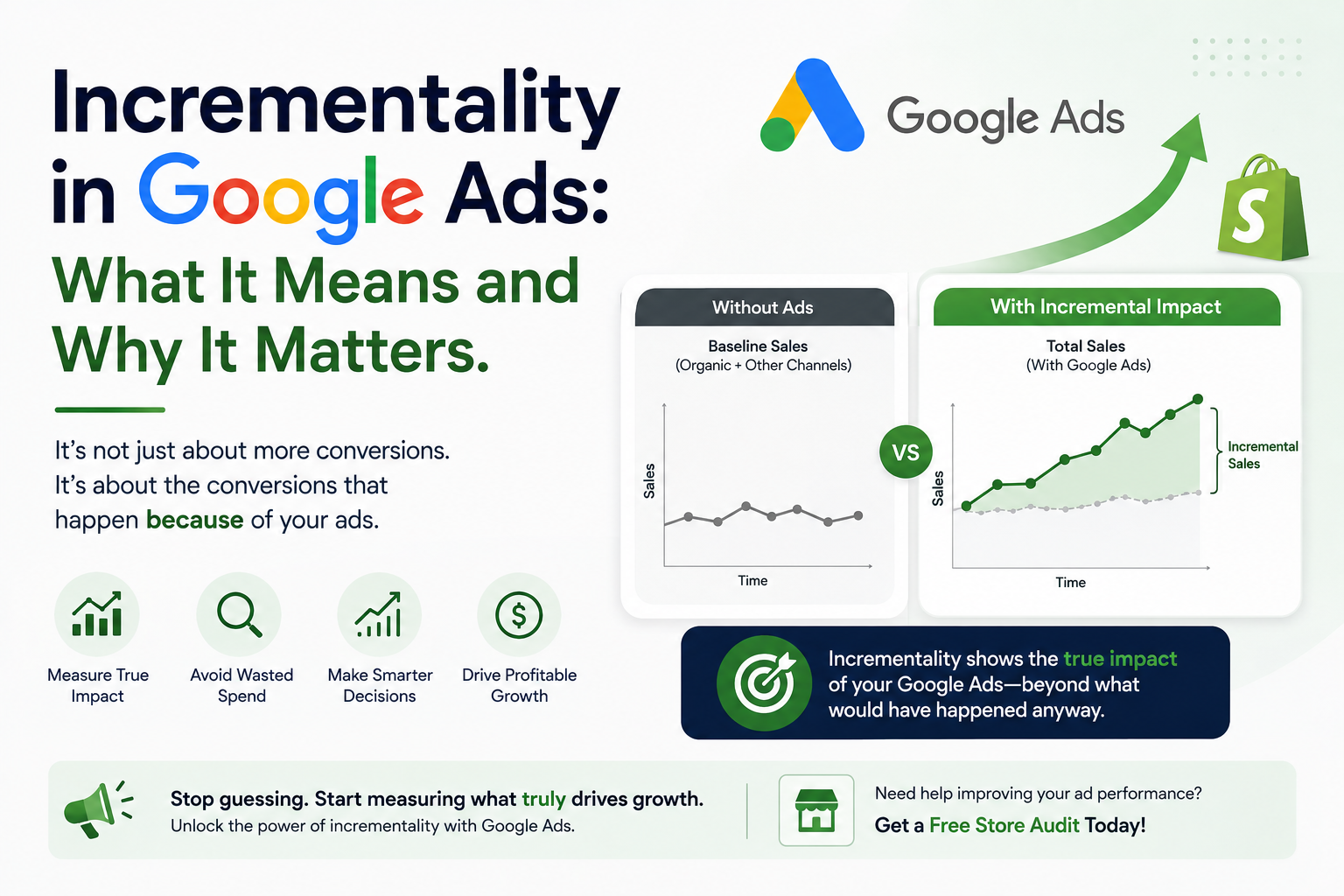
We've touched on this idea across our last two posts — first explaining what incrementality means and then looking at how to check whether your ads are actually driving new sales. This post ties it together by getting precise about the terminology, because once this distinction clicks, a lot of confusing ad performance suddenly makes sense.
Attributed Conversions: What Google Is Actually Counting
An attributed conversion is simply this: a sale that Google Ads has decided, based on its attribution model, to credit to one of your ads.
That sounds straightforward, but "based on its attribution model" is doing a lot of work in that sentence. Google is essentially following a trail of clicks and impressions and then applying rules to decide which touchpoint (or touchpoints) get the credit. Depending on your settings, that might be last-click, data-driven attribution, or something else entirely.
The important thing to understand is that attribution is a bookkeeping decision, not a measurement of cause and effect. It answers "which ad was in the customer's path before they bought?" It does not answer "did that ad actually cause them to buy?" Those are very different questions, and Google Ads is only built to answer the first one.
This is why a customer who already intended to buy from you, clicked a branded search ad out of habit on their way to checkout, and would have converted with or without that ad — still shows up as an attributed conversion. Google isn't wrong, exactly. It's just answering a narrower question than most people assume.
Incremental Conversions: What Actually Happened Because of the Ad
An incremental conversion is the sale that specifically would not have happened without the ad. It strips out everyone who would've bought anyway through some other path — organic search, direct traffic, an email, a friend's recommendation, simply typing your URL from memory — and counts only the people the ad genuinely pulled in.
This number is almost always smaller than your attributed conversion count. Sometimes a lot smaller. And that's normal — it's not a sign something is broken. It just reflects reality: not every touchpoint in a customer's journey was necessary for the sale to happen.
You can't get incremental conversions straight out of the Google Ads dashboard the way you can pull up attributed conversions. It requires some form of testing — geo holdouts, conversion lift studies, or pause tests — to estimate. That extra effort is exactly why so many advertisers skip it and just optimize toward attributed numbers instead. It's easier, even if it's less accurate.
Why the Gap Between Them Matters So Much
Here's where it gets practical. The size of the gap between attributed and incremental conversions tends to vary a lot by campaign type:
- Branded search usually has a huge gap — high attributed conversions, much lower incremental value, since people searching your brand name were often already coming to buy.
- Remarketing usually falls somewhere in the middle — some real incremental lift from timely reminders, some just claiming credit for people already planning to return.
- Broad prospecting and cold audience campaigns (like Performance Max targeting new customers, or non-brand search) tend to have a smaller gap, because these are reaching people who genuinely didn't know about you before seeing the ad.
If you only ever look at attributed numbers, prospecting campaigns will almost always look "worse" than branded or remarketing campaigns, because their ROAS is naturally lower for people further from a purchase decision. But those campaigns might actually be doing more of the real, incremental work of growing your customer base. Judge everything by attribution alone, and you'll keep starving your best growth engine to feed campaigns that were mostly going to convert anyway.
The Takeaway
Attributed conversions tell you where Google thinks the credit belongs. Incremental conversions tell you what your ad spend actually earned you. A healthy Google Ads strategy uses attribution for day-to-day optimization — it's fast, and Google's algorithms need it to function — while periodically checking incrementality to make sure the bigger budget decisions are grounded in reality, not just clever bookkeeping.
If this has you second-guessing what your own reports have been telling you, that's a completely normal reaction — and a good one to act on. Our team runs exactly this kind of analysis for Shopify brands: separating what's genuinely working from what's just claiming credit. Grab a free Google Ads and store audit here, and we'll walk you through what your account's numbers are really saying.