

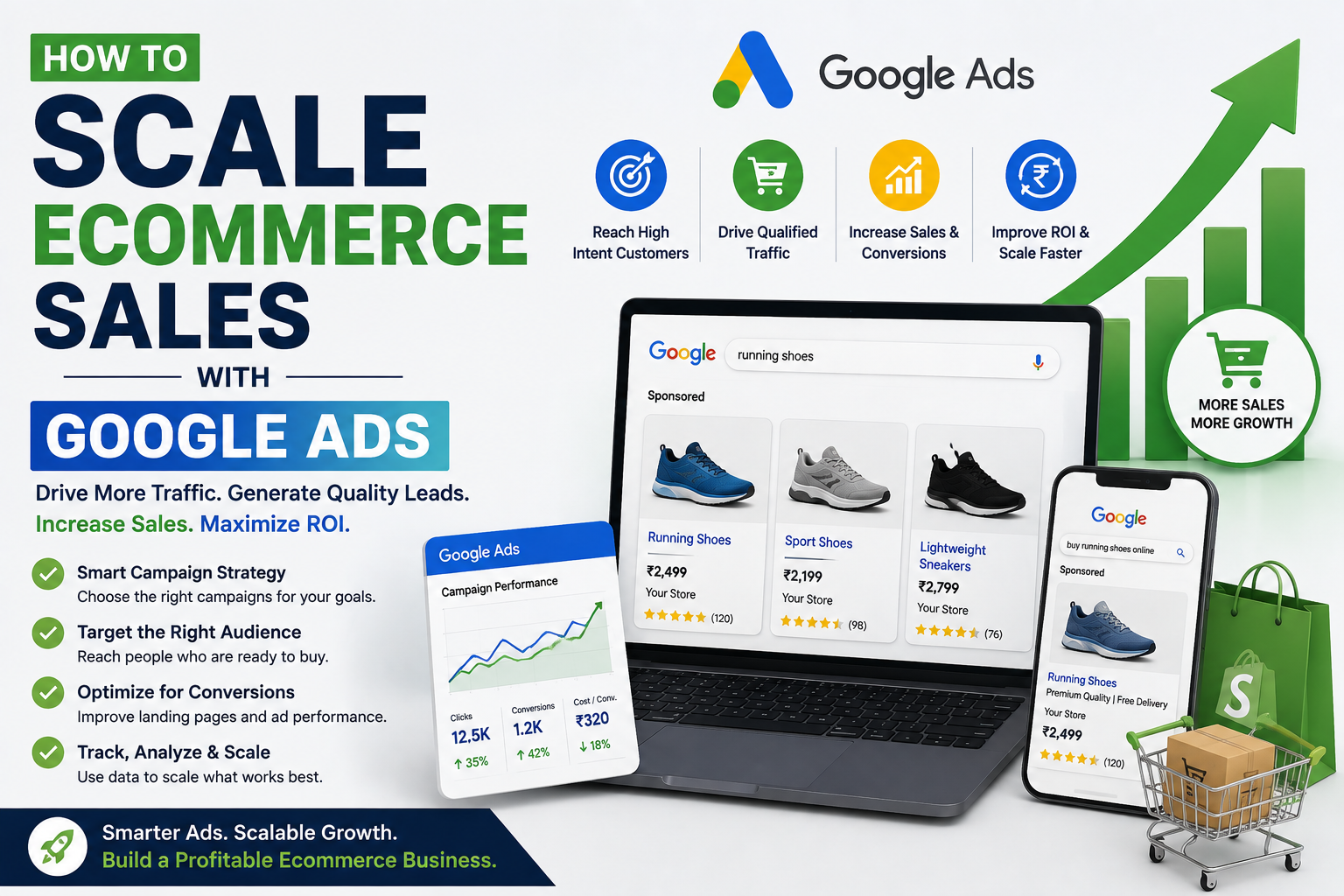
Most ecommerce brands hit the same wall: Google Ads works well at a modest budget, then performance degrades the moment spend increases. CPAs creep up, ROAS slides, and the instinct is to blame the platform. Usually the real cause is that scaling was attempted by turning up a dial instead of rebuilding the account to handle more volume. Scaling profitably is a structural problem, not a bidding problem.
Why Scaling Breaks Performance
Google Ads allocates budget toward whatever is winning auctions right now. At low spend, a handful of top-performing keywords or products absorb the budget comfortably. Increase spend without expanding what the account can profitably bid on, and the extra budget gets forced into lower-intent queries, broader audiences, and more expensive auctions — the same pattern that inflates ROAS numbers without inflating real demand. We've written about why that reported number can mislead you at any budget level in Why ROAS Doesn't Tell the Full Story: The Case for Incrementality — it becomes especially relevant once you're scaling, because more spend usually means more of it is chasing demand that would have converted anyway.
Fix the Foundation Before Raising Budget
Three things need to be right before more spend will translate into more profitable sales:
Conversion tracking. If tracking is inflated, duplicated, or missing post-purchase events, Smart Bidding is optimizing toward the wrong signal. This compounds at scale — a small tracking error at low budget becomes a large misallocation at high budget.
Product feed quality. For Shopping and Performance Max, incomplete titles, missing GTINs, or thin product data cap how many queries Google can confidently match you to. A feed that works at low spend often can't support the query volume that comes with scaling.
Landing page and site experience. More traffic exposes more friction. A checkout issue that cost you 2% of conversions at low volume costs proportionally more in absolute revenue once volume doubles or triples. If campaigns are already underperforming for reasons unrelated to budget, that gets diagnosed in Why Your Shopify Google Ads Campaigns Aren't Converting — worth ruling out before scaling makes the same problem more expensive.
A Structured Approach to Scaling
1. Expand horizontally before vertically. Before pushing more budget into existing winning campaigns, add adjacent campaigns: new product categories in Shopping, new keyword themes in Search, new audience segments in Performance Max. This spreads growth across more profitable inventory instead of forcing existing campaigns into diminishing returns.
2. Increase budgets in increments, not leaps. A 20–30% budget increase every 1–2 weeks lets Smart Bidding adjust without losing its learning phase. Doubling budget overnight usually triggers a temporary performance dip while the algorithm re-learns, and on a tight cash cycle that dip is expensive.
3. Separate brand and non-brand spend. Brand campaigns typically have low CPCs and high conversion rates, which can mask weaker non-brand performance in blended reporting. Scaling should be evaluated primarily on non-brand and prospecting campaigns, since that's where new customer growth actually comes from.
4. Layer in Performance Max carefully. PMax can unlock incremental reach across Search, Shopping, Display, and YouTube inventory, but it also obscures where budget is going. Run it alongside — not instead of — structured Search and Shopping campaigns, and monitor search-term insights regularly to catch irrelevant spend.
5. Test incrementality as you scale, not after. The point where scaling stops being profitable isn't always visible in ROAS. A geo holdout or conversion lift test at each new budget tier tells you whether the extra spend is generating real incremental revenue or just more attributed revenue. We break down how to run that test in What Happens When You Stop Google Ads? The Holdout Test Explained.
Where Shopping Fits Into Scaling
For most ecommerce catalogs, Shopping campaigns are the primary scaling lever because they can absorb budget across an entire product range without new copywriting or keyword research for every SKU. Getting the balance right between Shopping and Search as budget grows is its own decision — covered in Google Shopping Ads vs Search Ads: Which One Should Get Your Budget? — and that balance tends to shift toward Shopping as spend increases, provided the feed can support it.
Signs You're Scaling the Wrong Way
- ROAS drops sharply within days of a budget increase and doesn't recover after the learning phase.
- New spend concentrates in a narrow set of high-competition keywords rather than spreading across the account.
- Search term reports show a rising share of loosely related or irrelevant queries.
- CPA increases faster than order volume, meaning growth is coming at a worsening unit cost rather than genuine expanded reach.
Any of these is a signal to pause and fix structure — feed, tracking, campaign segmentation — rather than push budget further into a system that's already straining.
The Bottom Line
Scaling Google Ads profitably isn't about spending more on what's already working; it's about expanding what the account is capable of winning auctions for, in increments the algorithm can absorb, while tracking whether the extra revenue is real or just better attributed. Get the foundation and pacing right, and Google Ads scales the same way the rest of the business should — deliberately, not by turning up a dial and hoping.
Related reading: Google Shopping Ads vs Search Ads: Which One Should Get Your Budget? · Why ROAS Doesn't Tell the Full Story: The Case for Incrementality · Why Your Shopify Google Ads Campaigns Aren't Converting