

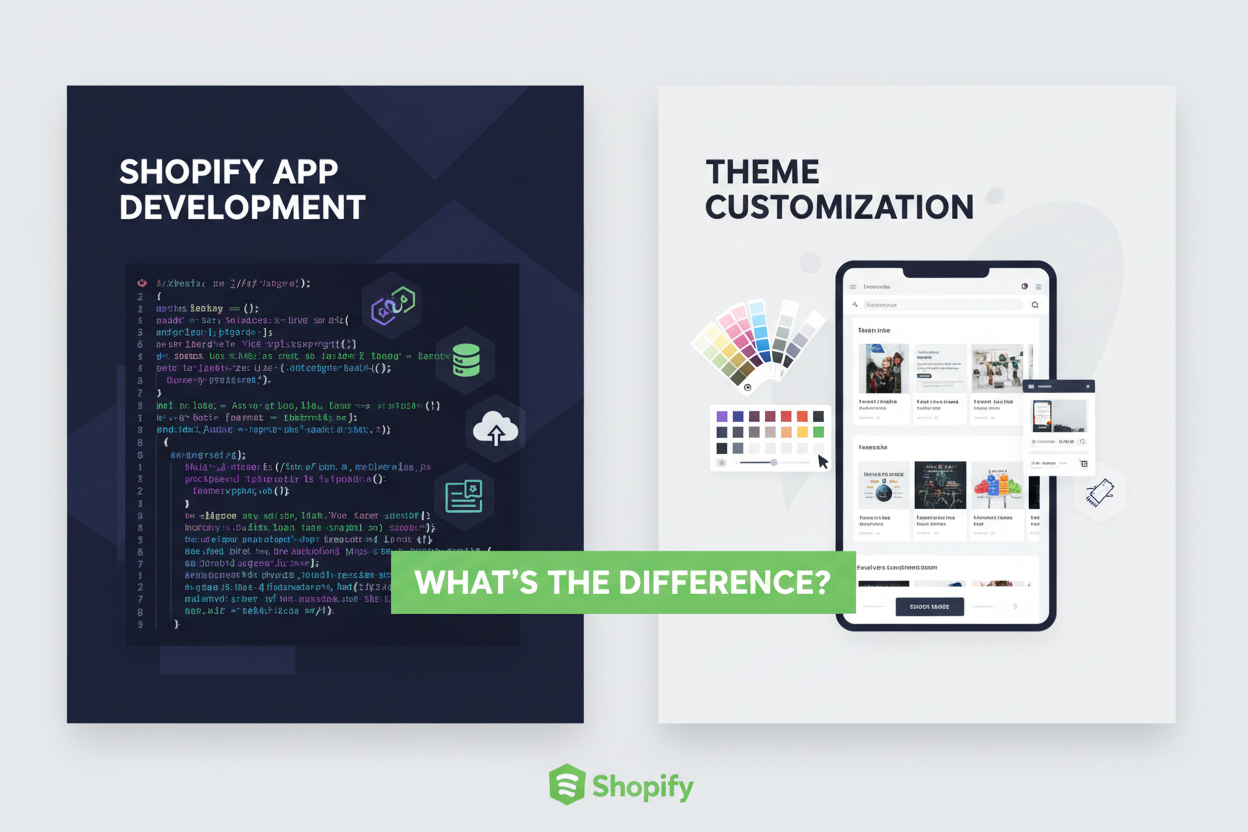
Short version: theme customization changes what shoppers see and how the storefront behaves. Shopify app development changes what your store can actually do — logic that runs on a schedule, talks to another system, or holds data Shopify has no field for. Most scaling questions we get from founders in the US, UK and Australia are really a sorting problem: is this a Liquid job, or does it need an app? Get that call wrong and you either pay for engineering you didn't need, or you bolt something fragile into a theme that breaks the next time you update it.
What theme customization actually covers
Your theme is the storefront. Liquid templates, JSON section files, CSS, storefront JavaScript, and the settings schema that lets your marketing lead move things around without calling a developer.
Real jobs that live here: a product page that shows size charts by collection, a bundle block above the add-to-cart button, a wholesale-only price display that reads a customer tag, a mega menu that doesn't fall apart on a 300-SKU catalogue, a cart drawer with free-shipping progress. Also the unglamorous stuff — cutting render-blocking scripts, lazy-loading below-the-fold images, killing the 400KB of unused CSS your last theme swap left behind.
Timelines are usually short. A single section build is one to three days. A full custom theme on top of Dawn or a premium base is typically three to seven weeks depending on how many templates need bespoke work. Rates vary wildly by geography; a London or Sydney studio will quote two to four times what an experienced Bengaluru team charges for the same Liquid work, which is why so much of it gets built offshore.
The limitation people discover late: theme code doesn't travel well. Customizations sit inside a specific theme version. When you upgrade, someone has to port them by hand. Ten small tweaks over two years quietly becomes a two-week migration cost.
What Shopify app development is for
An app is a separate application with its own hosting and database that connects to Shopify through the Admin API, webhooks, and increasingly through extensions that inject into checkout, the customer account pages, or Shopify Functions. It runs whether or not anyone is looking at your storefront.
You need an app when the requirement involves any of these:
- Logic on a schedule. Prices that refresh every fifteen minutes, stock syncing overnight, a nightly reconciliation with your ERP.
- Data Shopify doesn't model. Serial numbers, rental windows, engraving queues, dealer territories, multi-tier wholesale price books.
- Talking to an outside system. NetSuite, Unleashed, Cin7, a 3PL, an accounting stack, a courier that has no Shopify integration worth using.
- Admin-side workflows. Your ops team needs a screen inside Shopify admin, not a spreadsheet.
- Discount or shipping rules the native engine can't express. That is Shopify Functions territory, which only ships inside an app.
A well-scoped custom app for a single merchant is usually a four to eight week build. It doesn't go through Shopify's app review because it isn't public, so you skip the five to ten business day review cycle and the App Store listing requirements. The trade-off is that you own the hosting bill and the maintenance. Budget for it. An app nobody has touched in eighteen months will eventually break on an API version deprecation, and Shopify deprecates on a schedule.
Three quick tests to tell them apart
When a brief lands on our desk, we run it through three questions before quoting anything.
Does it need to run when the browser is closed? If yes, it's an app. Anything triggered by time or by a webhook cannot live in Liquid.
Does it need to store something Shopify has no home for? Metafields cover more than people think, and metaobjects cover a lot more again. If metafields do the job, you can often stay in the theme. If you need relational data with history, you need a database, so you need an app.
Will a non-technical person need to change it weekly? Then it needs a settings interface. Theme settings work fine for copy and toggles. Anything more complex belongs in an embedded admin app.
Use cases by business type
Retailers. A UK homeware retailer with 40 physical stores wanted store-level stock on the product page. Theme work displays it. An app is what keeps it accurate, because the data comes from a POS system on a five-minute sync. Both, in sequence.
Wholesalers. Customer-specific pricing, minimum order quantities per SKU, net-30 terms, a quick-order pad by product code. The order pad is a theme template. The price book and the terms logic are an app. Wholesalers routinely try to solve this with tags and discount codes, and it holds together up to about 30 accounts before it doesn't.
D2C brands. Subscription upsells, quiz-driven recommendations, post-purchase upsells in checkout. Most of this is off-the-shelf app plus theme integration. The mistake we see is installing seven apps that each inject their own script, then wondering why the LCP on mobile sits at 4.1 seconds.
When buying beats building
Say the unwelcome thing first: if an existing app on the App Store covers 85% of your requirement for $49 a month, build nothing. A custom app that costs $18,000 to build and $400 a month to host has to save real money or unlock real revenue to beat that maths, and "it would be exactly how we want it" is not a business case.
We publish our own apps for exactly this reason. Thriftizer's Shopify apps came out of problems we kept solving from scratch for merchants. Gold & Silver Live Rate handles jewellery pricing tied to live metal rates, which is a scheduled-job problem no theme edit can solve. FilterPro does smart product filters and AI search, the thing every catalogue over about 2,000 SKUs needs and every native filter set struggles with. SwiftStore automates PageSpeed work that would otherwise be a recurring line item on your dev invoice. If one of those fits, install it and spend the budget elsewhere.
Where nothing fits, that's when Shopify app development services earn their fee. Custom apps make sense for logic that is specific to how your business actually operates.
How the two work together
Nearly every project we ship is a mix. The app owns the data and the rules. The theme owns the presentation. Keep that line clean and both sides stay maintainable.
A concrete pattern: the app writes computed values to metafields or metaobjects, and the theme reads them in Liquid. No storefront API call, no client-side fetch, no loading spinner. The page renders server-side and stays fast. When we redesign the theme two years later, the app doesn't care, because nothing about the data layer changed.
The opposite pattern, where a theme file calls a third-party endpoint on page load, is how stores end up with a 900ms blocking request on every product view. It works in staging. It falls over during a Black Friday traffic spike.
What each one costs, honestly
Ranges, not quotes, and they move with scope:
- Small theme fixes and section builds: a few hundred dollars to about $2,500.
- Full custom theme on a solid base: $6,000 to $25,000, higher if you need bespoke templates for wholesale, B2B, or multi-currency variants.
- Custom app, single-merchant, moderate complexity: $10,000 to $35,000, plus hosting and maintenance from around $150 a month.
- Public App Store app with billing, review, docs and support: meaningfully more, and the ongoing support load is the part founders underestimate.
Offshore delivery changes these numbers a lot, and the quality gap that existed a decade ago has mostly closed for Shopify work specifically. Our detailed breakdown of Shopify development costs has the comparison if you're benchmarking quotes.
FAQ
Can theme customization replace an app? Sometimes, and it's worth checking before you commission a build. Metafields, metaobjects and Liquid can handle more display logic than most people assume. If the requirement is purely presentational, stay in the theme.
Will a custom app slow my store down? A well-built one shouldn't. Apps that write to metafields and let Liquid render the output add nothing to page weight. Apps that inject client-side scripts on every page do. Ask any developer, ours included, exactly what their app loads on the storefront.
Do I need Shopify Plus for a custom app? No. Custom apps work on every plan. Plus matters for checkout extensibility limits, higher API rate ceilings, B2B features and Shopify Functions scale, so it becomes relevant as the app grows more ambitious.
How long does a custom Shopify app take? Four to eight weeks for a focused single-merchant build, assuming decisions get made quickly and API access to your other systems exists. Integrations with legacy ERPs are usually the schedule risk, not the Shopify side.
What happens to my theme customizations when I change themes? They don't carry over. Someone reimplements them. This is the strongest argument for pushing logic out of the theme and into an app or into metafields when you have the choice.
Should I hire in-house or work with an agency? If you ship storefront changes weekly, an in-house Shopify developer pays for themselves. For project work with a defined end, an agency is cheaper and faster. Plenty of brands do both: a dedicated developer for ongoing work, an agency for the app builds.
How do I know which one I need? Write down the requirement in one sentence, then apply the three tests above. If the answer is still unclear, it's usually because the requirement has two halves.
Next step
If you're sitting on a list of "things the store can't do yet", get a second opinion before you commission anything. Our free Shopify store audit looks at your theme, your installed apps, your Core Web Vitals and your actual requirement list, then tells you which items are a two-day Liquid job and which genuinely need an app built. Some of it, you'll be able to solve with an app that already exists.