

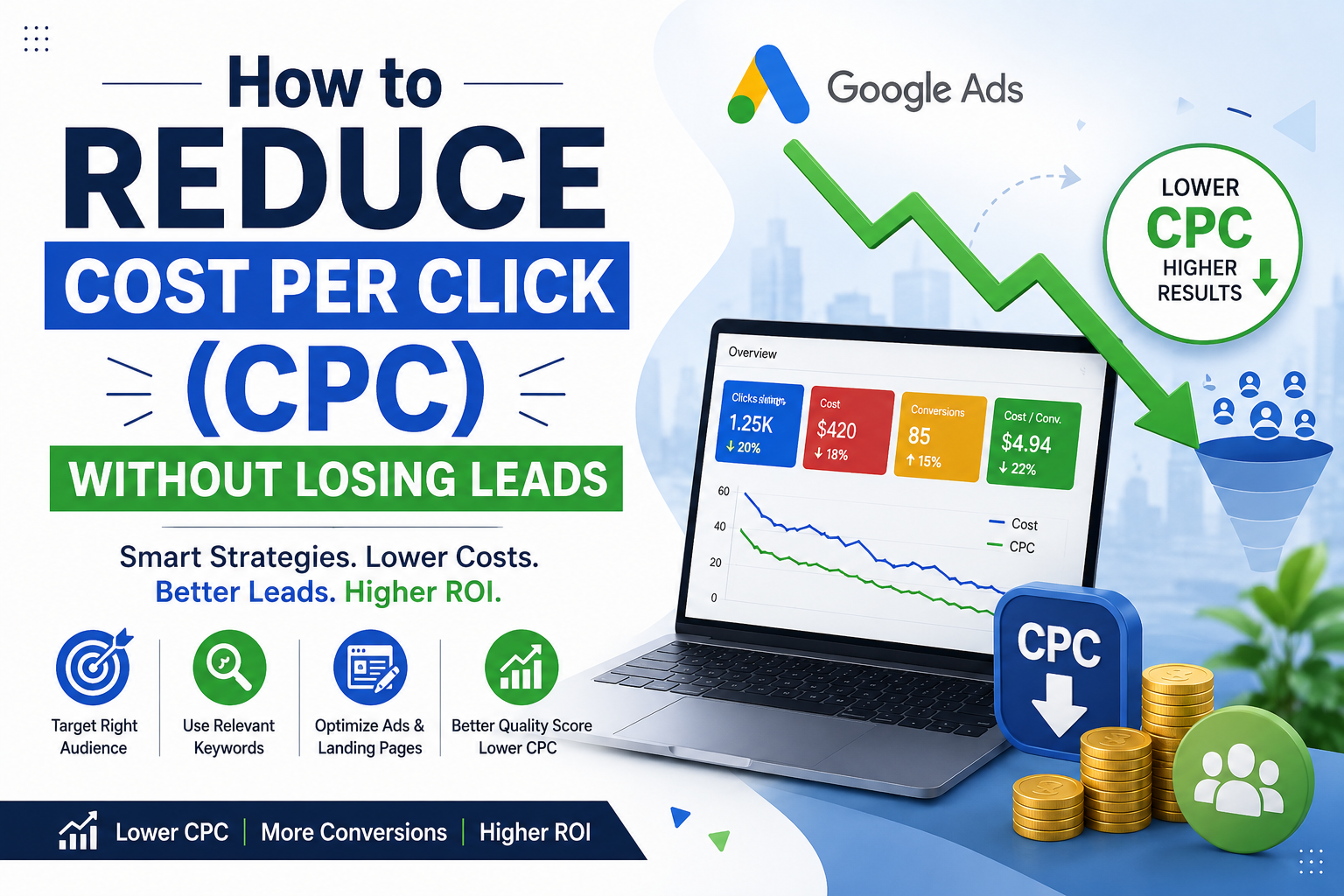
Many businesses assume that the only way to get more leads is to spend more money on Google Ads. In reality, that's rarely the case.
If you're paying too much for every click, the problem usually isn't your budget—it's how your campaigns are set up.
A high Cost Per Click (CPC) can quickly drain your advertising budget, leaving fewer opportunities to generate sales. The good news is that reducing CPC doesn't mean lowering your bids until your traffic disappears. It's about making your campaigns more relevant so Google charges less while still showing your ads to people who are ready to buy.
Let's look at practical ways to reduce CPC without losing valuable leads.
Also Read: Why Your Google Ads Budget Disappears Quickly
Why CPC Matters
Cost Per Click is the amount you pay whenever someone clicks your ad.
A lower CPC means you can:
- Get more clicks with the same budget
- Generate more leads
- Improve your return on ad spend (ROAS)
- Scale campaigns without dramatically increasing costs
But lowering CPC should never come at the expense of lead quality. Cheap clicks that never convert are simply wasted money.
1. Improve Your Quality Score
Google rewards advertisers who create relevant, useful ads.
Quality Score is based on three main factors:
- Expected click-through rate
- Ad relevance
- Landing page experience
The higher your Quality Score, the less you often pay for the same position.
Simple improvements include:
- Matching keywords with ad copy
- Creating dedicated landing pages
- Improving page speed
- Writing clear, relevant headlines
A small increase in Quality Score can significantly reduce CPC over time.
2. Stop Targeting Too Many Keywords
One of the biggest mistakes businesses make is trying to rank for everything.
Instead of targeting broad keywords like:
Running shoes
Focus on more specific searches such as:
- Lightweight running shoes for women
- Trail running shoes
- Running shoes for flat feet
Long-tail keywords usually:
- Cost less
- Have lower competition
- Convert better
- Attract more qualified visitors
Quality traffic almost always beats high traffic.
3. Use Negative Keywords
Negative keywords prevent your ads from showing for irrelevant searches.
For example, if you sell premium Shopify development services, you probably don't want traffic searching for:
- Free Shopify themes
- Shopify jobs
- Shopify tutorial
- Shopify course
Every irrelevant click increases your CPC and lowers campaign performance.
Review your Search Terms report regularly and continue expanding your negative keyword list.
4. Write Ads That Match Search Intent
Google prefers ads that closely match what users are searching for.
Instead of generic headlines like:
"Best Digital Marketing Company"
Try something more specific:
- Reduce Your Google Ads CPC
- Lower Advertising Costs Today
- Improve ROAS Without Increasing Budget
When users immediately recognize that your ad answers their search, they're more likely to click.
Higher click-through rates often contribute to better Quality Scores and lower CPC.
5. Create Smaller Ad Groups
Many advertisers place dozens of unrelated keywords inside one ad group.
That usually leads to generic ads.
Instead, organize campaigns into tightly themed groups.
For example:
Campaign:
Google Ads Services
Ad Group 1
- Reduce CPC
- Lower Google Ads Costs
Ad Group 2
- Google Ads Audit
- PPC Campaign Review
Ad Group 3
- Increase ROAS
- Improve Conversion Rate
Smaller ad groups allow you to create highly relevant ads, improving both Quality Score and conversions.
6. Optimize Your Landing Pages
Many advertisers focus only on Google Ads while ignoring the page visitors actually land on.
Google evaluates landing pages based on:
- Loading speed
- Mobile friendliness
- Useful content
- Easy navigation
- Relevance to the keyword
A better landing page often means lower CPC and higher conversion rates.
If users quickly leave your website, Google notices.
7. Target the Right Locations
Don't advertise everywhere if your business only serves specific regions.
Instead, target:
- Cities
- States
- Countries
- Service areas
For example, if your business primarily serves businesses in Bangalore or the USA, exclude regions that rarely convert.
Location optimization helps reduce wasted clicks and improves overall campaign efficiency.
8. Schedule Ads During High-Converting Hours
Not every hour performs equally.
Review your Google Ads reports to identify:
- Days with the most conversions
- Hours with the lowest CPC
- Times when users are most likely to purchase
Then increase bids during high-performing periods and reduce them when conversions are low.
This simple adjustment can significantly improve campaign efficiency.
9. Test Multiple Ad Variations
Never assume your first ad is the best one.
Test different:
- Headlines
- Descriptions
- Calls to action
- Display paths
Even small improvements in click-through rate can gradually reduce CPC while increasing conversions.
Continuous testing is one of the easiest ways to improve long-term performance.
10. Focus on Conversion Rate, Not Just CPC
Many advertisers celebrate lowering CPC by 30%.
But if conversions also fall by 40%, the campaign actually performs worse.
Instead of chasing the cheapest clicks, focus on metrics like:
- Cost Per Lead
- Conversion Rate
- Return on Ad Spend
- Revenue Generated
The goal isn't to buy cheaper traffic—it's to generate profitable customers.
Common Mistakes That Increase CPC
Avoid these common issues:
- Using broad match keywords without monitoring
- Ignoring negative keywords
- Sending all traffic to the homepage
- Running outdated ad copy
- Poor mobile experience
- Slow-loading landing pages
- Never reviewing Search Terms reports
- Making changes too frequently without enough data
Fixing these problems can often lower advertising costs without increasing your budget.
Final Thoughts
Reducing Cost Per Click isn't about finding shortcuts or simply lowering your bids. It's about creating better campaigns that connect the right audience with the right message at the right time.
When your keywords, ads, and landing pages work together, Google rewards that relevance with lower CPCs, stronger Quality Scores, and better lead quality. Instead of focusing only on paying less for each click, focus on making every click more valuable.
Small, consistent improvements can lead to lower advertising costs, more qualified leads, and better long-term results.
Get a Free Store Audit
If your Google Ads budget disappears quickly without delivering enough sales, the issue may be deeper than your campaigns. Your website, landing pages, or conversion funnel could be limiting your results.
Thriftizer Solutions offers a Free Store Audit to identify what's increasing your advertising costs and uncover practical ways to improve conversions, lower CPC, and maximize your return on every click.