

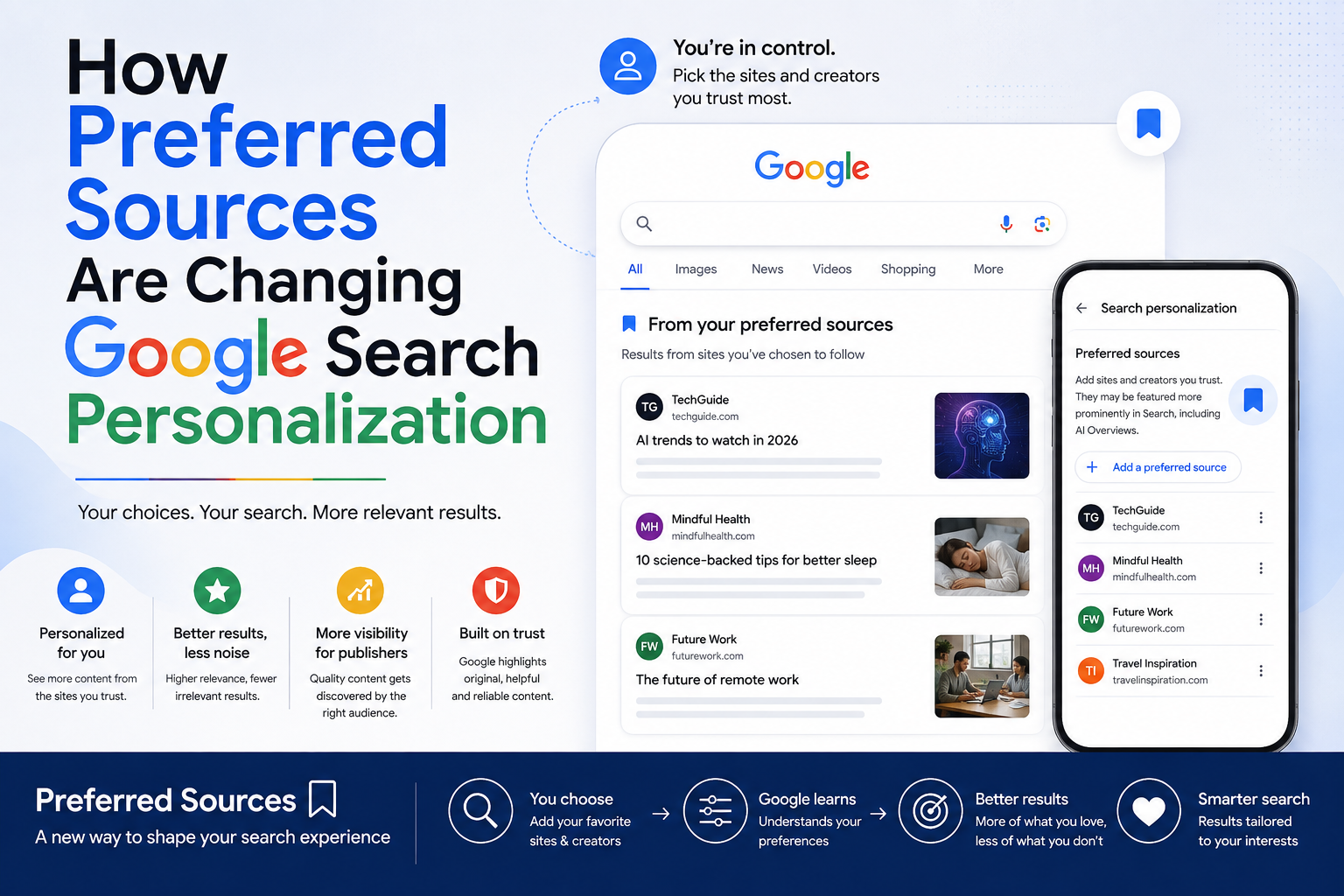
Google's Preferred Sources lets a person tell Search which publishers they want to see more of. You tap an icon next to the Top Stories block, search for sites, tick the ones you like, and those sites start showing up more often for news-shaped queries, plus in a separate block of results pulled from the sites you picked. It rolled out in English in the US and India in 2025 after a stint in Search Labs. If you sell serums or sneakers on Shopify, here is the blunt version: this feature will do nothing for your traffic this quarter, and there is no way to optimise for it. What it does do is confirm the direction Google Search personalization has been heading for years, and that direction has real consequences for how you budget content and how you read your own reports.
Also Read: What are Google Preferred Sources
What the feature actually does
It is an opt-in layer, controlled by the user, sitting on top of the normal ranking system. The searcher chooses. Not a signal, not a score, not something you can earn with better markup. A reader who follows three cricket sites and two business dailies can tell Google to weight those five above whatever the algorithm would otherwise have surfaced in Top Stories.
Two things follow. First, it only bites on queries that trigger news surfaces, which for most D2C catalogues means almost never. Nobody's Top Stories block is going to fill up with product listings for cold-pressed oil. Second, the mechanism is preference, not authority. Google is admitting that for a slice of queries, it would rather ask the user than guess.
Why you cannot optimise for Preferred Sources
Agencies will sell you a package for this. Do not buy it. There is no schema, no meta tag, no internal linking pattern that makes a store more likely to be added as someone's preferred source. The only route in is a human deciding they want to hear from you regularly, then taking four taps to say so. That is a brand outcome with an interface attached.
The one adjacent thing worth doing costs nothing: make sure your content actually has a publication identity. A consistent author, a real About page, a masthead if you run something magazine-shaped, dates that are true. If you publish under a name people recognise, you are pickable. If your blog is forty posts of "Top 5 Benefits of Ashwagandha" with no byline, you are not, and no amount of technical work fixes that.
Personalization already broke your rank report
This is the part worth your attention. Long before Preferred Sources, two people searching the same phrase were getting different pages. Location, device, language, prior clicks, Discover history, whether they are signed in. Add AI Overviews reshuffling what sits above the first blue link, and add an explicit user-controlled preference layer, and "we rank #4 for X" becomes a statement about one datacentre's opinion on one Tuesday.
We still track positions. But we treat them as a directional health check, not a KPI, and we stopped putting average position on the front page of client reports about two years ago. It caused more arguments than decisions. A keyword can slide from 3 to 6 while clicks go up, because the SERP layout changed and the block you now sit in gets more attention. The reverse happens too.
The arithmetic of a blog nobody would choose
Run the numbers on your own content spend before you commission another quarter of it. Take a store publishing four posts a month at ₹8,000 a post, so ₹32,000 a month, ₹3,84,000 for the year, 48 posts.
Now open GA4 or your Search Console landing-page report and sort blog URLs by organic entrances. In most catalogues we audit, the distribution is brutal: six or seven posts carry the large majority of entry sessions and the rest carry a trickle. If six posts bring 80% of the traffic, the other 42 cost 42 × ₹8,000 = ₹3,36,000 and delivered the remaining 20%. Same annual budget spent as two deep buying guides a month instead of four thin ones gets you 24 pieces at ₹16,000 each, and those are the pieces that can rank for commercial queries, get cited in AI Overviews, and give a reader a reason to remember your name.
Check the split on your own store. The exercise takes twenty minutes and it usually changes the plan.
What being "pickable" looks like for a commerce brand
You are not going to become someone's preferred news source. What you can be is the site a category buyer returns to without a search query in between. The mechanics are unglamorous:
- One or two genuinely useful reference pages that people bookmark. A size and fit guide with real measurements. A fabric care page. A metal purity and hallmarking explainer, if you sell jewellery.
- Email and WhatsApp lists that you actually mail, because owned channels are the only distribution nobody can re-rank. A list of 12,000 that opens at 34% is worth more than a ranking you rent.
- A recognisable voice. Founder-written posts do better than agency-written posts on this specific axis, and we say that while being the agency.
- Being findable inside your own site. If someone lands on a guide and cannot get from there to the eleven relevant SKUs in two clicks, the visit was decoration. Large catalogues need real filtering and search, not a collection page with 340 products and a sort-by-price dropdown.
That last one is where most of our content and SEO work ends up focused, because the gap between traffic and revenue is usually on-site, not in the SERP.
Measure demand for your name, not your position
If search results are personalized per user, the durable metric is how many people come looking for you specifically. Four numbers, monthly:
- Branded query clicks in Search Console. Filter queries containing your brand name and its common misspellings. This is the closest thing to a brand-equity meter you get for free.
- Direct and email sessions as a share of total. If organic non-brand is 70% of your traffic, you are one algorithm update away from a bad quarter.
- Returning-visitor conversion rate versus new. A wide gap means your product is fine and your discovery is expensive.
- Repeat purchase rate at 90 days. Not a search metric. It is the one that decides whether any of this pays.
A worked version: a store doing 5,200 organic sessions a month, of which 640 are branded. That is 12.3%. If branded sessions convert at 3.8% and non-brand at 1.1%, branded is 24 orders and non-brand is 50. Push branded share to 20% of the same total, 1,040 sessions, and you get 40 orders from the same traffic volume, without touching a single ranking. Use your own conversion rates; the shape of the answer rarely changes.
If you do land in a news surface, page weight decides the rest
Occasionally a commerce brand does get pulled into Top Stories or Discover, usually off a launch, a funding round, or a founder interview. Those clicks arrive on mobile, on patchy 4G, from people with zero loyalty. A 4.1s LCP on a product page means most of them never see it. We have watched a spike of 30,000 Discover sessions convert at roughly nothing because the theme was loading six app scripts before first paint.
If your mobile LCP is above 2.5s, fix that before you commission another content calendar. A speed audit usually finds the culprits in an afternoon, and if you would rather watch the score yourself over time, SwiftStore scans a store, fixes what it can and keeps a history so you notice the day a new app adds 400ms.
Where India sits in this
India was in the first wave alongside the US, in English, which matters more for publishers than for retailers. Indian D2C discovery still runs heavily through Instagram, WhatsApp forwards and marketplaces, and English-language Top Stories personalization sits some distance from where a Tier-2 buyer finds a new brand. The transferable lesson is the same one COD taught everyone: channels you do not own will change their terms without asking you. Google is now letting users change the terms directly.
Practically, for a store selling in India: keep investing in the queries that carry purchase intent, get your product data clean enough that AI Overviews and Shopping surfaces can read it, and treat your email list and repeat-purchase engine as the actual moat. Preferred Sources is a signal about the weather, not a storm you need to prepare for.
Start here
Pull two reports this week. First, blog landing pages sorted by organic entrances for the last 12 months, so you can see how much of your content budget is dead weight. Second, branded versus non-branded clicks in Search Console, so you know how much of your demand you actually own. If those two numbers look worse than you expected, our free audit covers both, along with the on-site reasons the traffic you already have is not converting.