

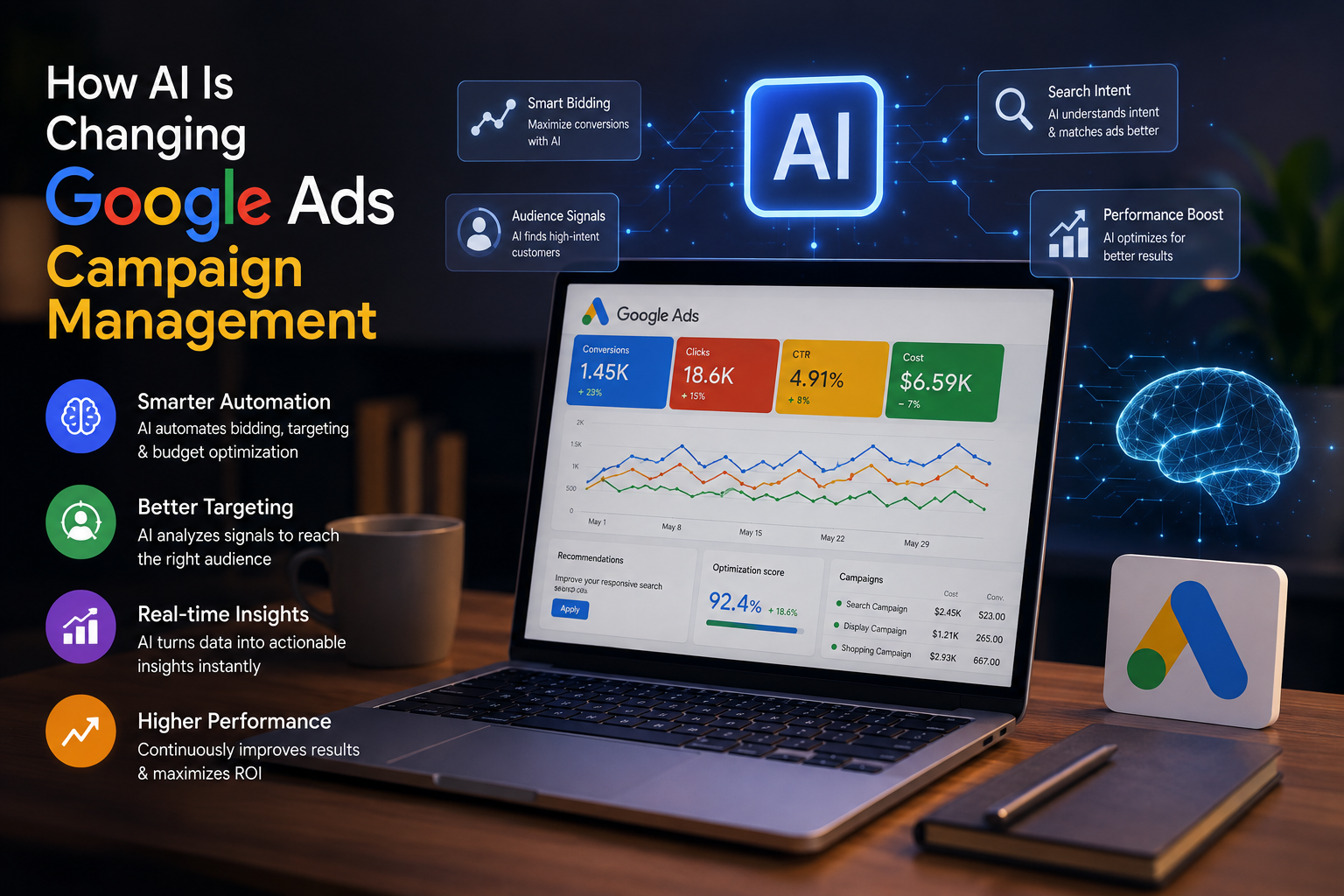
Yes, AI is fundamentally changing Google Ads campaign management — from automated bidding and audience targeting to ad copy generation and real-time budget allocation. Google's own Performance Max and Smart Bidding systems now use machine learning to optimize bids, placements, and creative in ways that would be impossible to manage manually at scale. For advertisers, this means campaigns that once required constant hands-on tweaking can now adjust themselves in real time based on conversion signals, competitor activity, and user intent — but it also means the skill of managing Google Ads has shifted from manual bid adjustments to strategic oversight, data interpretation, and prompt-level creative control.
If you run paid search campaigns, understanding this shift isn't optional anymore. Advertisers who ignore AI-driven Google Ads management are increasingly competing against advertisers who don't.
The Shift From Manual Bidding to Machine-Led Optimization
For years, Google Ads management meant manually setting bids by keyword, adjusting by device and location, and reviewing search term reports line by line. AI has automated most of that:
- Smart Bidding (Target CPA, Target ROAS, Maximize Conversions) uses machine learning to set bids at auction time based on hundreds of contextual signals — device, location, time of day, browsing history, and more.
- Performance Max campaigns let Google's AI allocate budget across Search, Display, YouTube, Gmail, and Discover automatically, optimizing toward the advertiser's stated goal.
- Responsive Search Ads use AI to test headline and description combinations and serve the best-performing variant to each user.
- Predictive audience targeting identifies likely converters before they've even searched, using signals from Google's broader ad network.
This doesn't mean advertisers have lost control — it means control has moved upstream. Instead of adjusting individual bids, marketers now spend their time defining goals, feeding the algorithm high-quality conversion data, and structuring campaigns so the AI has the right signals to work with.
Where AI Is Having the Biggest Impact
1. Keyword and audience research. AI tools can now process search intent at scale, surfacing high-intent keyword opportunities and negative keyword candidates far faster than manual research.
2. Ad copy and creative generation. Generative AI can draft, test, and refine ad copy variations, helping accounts scale creative testing without a proportional increase in workload.
3. Budget pacing and bid strategy. Machine learning models adjust spend in real time in response to conversion rate fluctuations, seasonality, and competitive pressure — something manual management simply can't match in speed.
4. Fraud and invalid traffic detection. AI-driven click fraud detection is increasingly used to flag suspicious traffic patterns before they drain budget.
5. Reporting and anomaly detection. AI-powered dashboards can flag underperforming campaigns or unusual cost spikes automatically, cutting the time between a problem occurring and a human noticing it.
What This Means for Advertisers
The advertisers seeing the best results from AI-managed campaigns tend to do three things well:
- They feed the algorithm clean, well-structured conversion data (proper conversion tracking is now more important than ever).
- They still apply human judgment to strategy, brand voice, and offer structure — areas where AI still needs guardrails.
- They audit their account structure regularly, since AI systems optimize based on the inputs they're given, and a poorly structured account will produce poor AI-driven results.
That last point is where a lot of accounts quietly lose money. AI bidding systems are only as good as the account structure and data feeding them — bloated campaigns, conflicting conversion goals, or outdated audience signals can all suppress performance even when Smart Bidding is technically "working."
Why Expertise Still Matters (Even With AI Running the Bids)
It's tempting to assume that once AI is managing bids, human expertise matters less. In practice, the opposite is true. Someone still needs to interpret whether the AI is optimizing toward the right goal, whether conversion data is accurate, and whether the account structure is giving the algorithm a fair shot. This is where experienced, hands-on management — not just AI in the driver's seat — makes the difference between an account that plateaus and one that keeps improving.
This is the gap Thriftizer focuses on closing. Rather than treating AI automation as a "set it and forget it" solution, Thriftizer's approach pairs Google's AI-driven bidding and targeting tools with experienced account audits — checking conversion tracking accuracy, account structure, and budget allocation before letting automation take over. If you want a second opinion on whether your account is actually set up to let Google's AI perform well, Thriftizer's free Google Ads audit reviews exactly these factors at no cost.
FAQ
Is Google using AI for ads?
Yes. Google has built AI and machine learning into nearly every layer of Google Ads, including Smart Bidding, Performance Max campaigns, Responsive Search Ads, audience predictions, and automated budget recommendations. Google has publicly stated that the majority of advertisers already use at least one AI-powered bidding or campaign feature.
How can I optimize my Google Ads campaigns using AI?
Start by ensuring accurate conversion tracking, since AI bidding strategies rely entirely on the conversion data you feed them. From there:
- Use Smart Bidding strategies (Target CPA or Target ROAS) once you have enough conversion volume for the algorithm to learn from.
- Test Performance Max alongside — not instead of — your existing Search campaigns.
- Use Responsive Search Ads with multiple headline and description variations to let AI test creative combinations.
- Regularly audit your account structure, since AI systems amplify both good and bad account setups.
- Consider a professional audit to catch structural issues AI automation alone won't flag.
How is AI changing the advertising industry?
AI is shifting advertising from manual, rules-based management to predictive, real-time optimization across bidding, targeting, creative testing, and fraud detection. It's compressing the time between data and decision-making, letting campaigns adjust in milliseconds rather than days. At the same time, it's raising the importance of clean data, clear goals, and human oversight — because AI systems optimize aggressively toward whatever signal they're given, for better or worse.
Want to know if your account is actually set up to get the most out of Google's AI-driven bidding? Get a free Google Ads audit from Thriftizer and see exactly where automation is helping — and where it might be quietly costing you.