

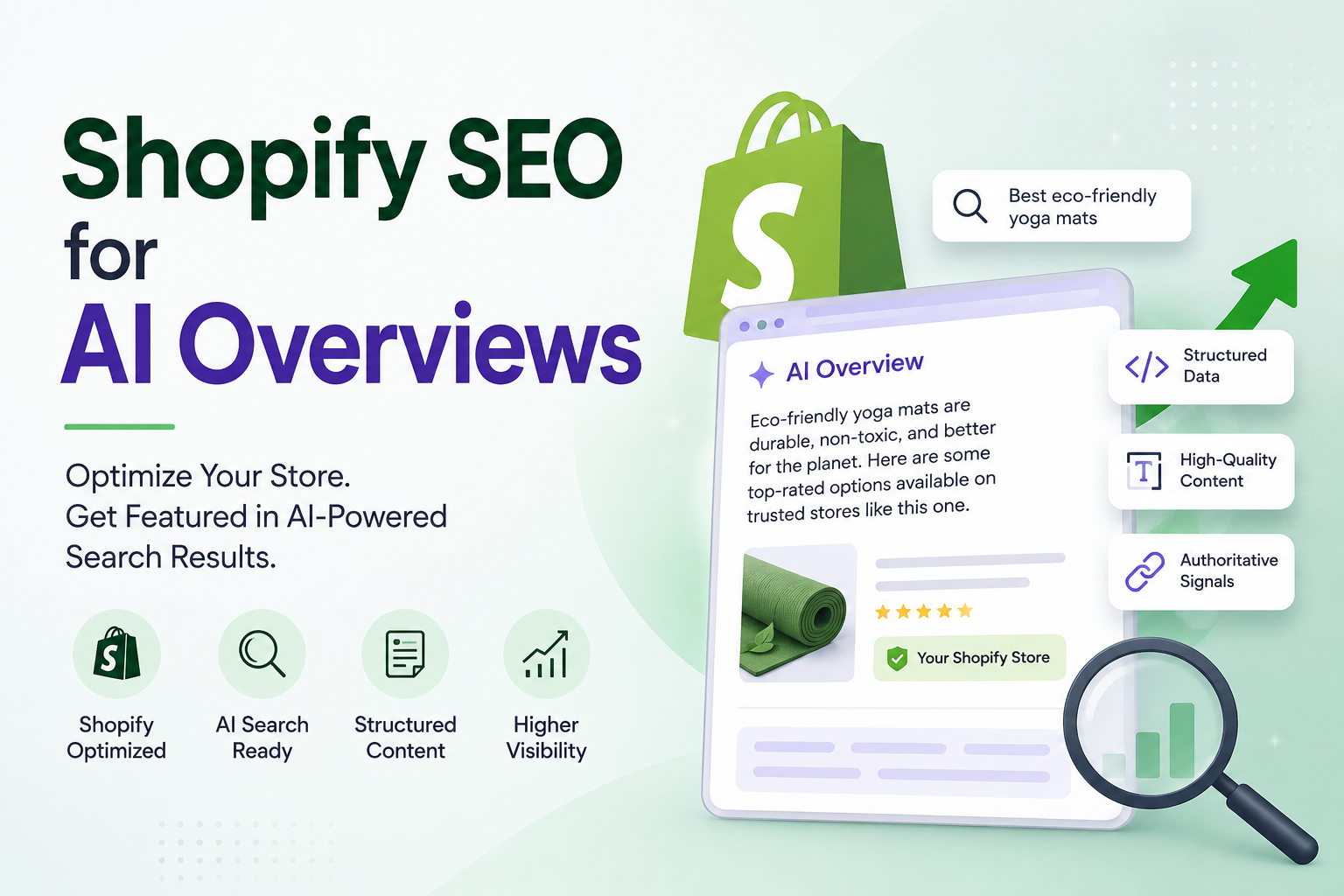
Google AI Overviews are AI-generated summaries that can appear at the top of Search for certain queries. Instead of simply showing a list of links, Google may provide a summarized answer and links to supporting websites.
For example, someone searching:
“What is the best skincare routine for sensitive skin?”
may see an AI-generated response that pulls information from multiple websites.
For a Shopify store, this creates a new opportunity. Your product guides, buying advice, category content, comparisons, and educational articles can potentially become supporting sources when Google generates an answer.
Google says there are no special technical requirements or special schema markup specifically required for AI Overviews. The same foundational SEO practices that help your website appear in Google Search continue to matter for AI features.
So, rather than chasing an “AI SEO hack,” Shopify brands should focus on building a website that is genuinely useful.
Why AI Overviews Matter for Shopify Stores
The traditional search journey was relatively simple:
Search → Click → Website → Product → Purchase
AI-powered search can introduce more steps:
Question → AI-generated answer → Supporting sources → Website → Product → Purchase
This means your store may be discovered before someone even searches directly for your brand.
A customer might ask Google:
- “What should I look for when buying running shoes?”
- “Best ingredients for dry skin?”
- “How do I choose the right office chair?”
- “What is the difference between cotton and linen?”
- “Which Shopify stores sell sustainable home products?”
If your content provides a strong, trustworthy answer, it has a better chance of becoming part of that discovery journey.
Google also says clicks from search results containing AI Overviews can be higher quality, with users more likely to spend time on the websites they visit.
1. Start With Strong Shopify Technical SEO
AI search still depends heavily on search engines being able to access, crawl, understand, and index your website.
That makes technical SEO the foundation.
For Shopify stores, check:
- Important pages are indexable
- Robots.txt isn't unnecessarily blocking important content
- XML sitemap is working correctly
- Canonical tags are properly configured
- Product and collection pages can be crawled
- Internal links connect related pages
- Mobile experience is strong
- Pages load quickly
- Duplicate URLs are controlled
- Important content is available as text
Google specifically recommends ensuring that pages are crawlable, indexable, and eligible to appear with a normal search snippet before they can be considered for AI features.
In simple terms: if Google can't properly understand your Shopify store, AI search can't reliably use it either.
2. Write Content That Answers Real Customer Questions
This is where many ecommerce websites fall short.
A product page saying:
“Premium quality. Shop now.”
doesn't give search engines—or customers—much useful information.
Instead, explain the things customers actually want to know.
For example, instead of only describing a leather backpack, create supporting content around:
“How to Choose a Leather Backpack for Work”
Then answer:
- What size works for laptops?
- Which leather types are durable?
- What features matter for daily commuting?
- How should leather be maintained?
- Is full-grain leather worth the price?
This creates useful context around your products while naturally covering the questions customers search for.
Google's current guidance emphasizes original, helpful, people-first content rather than content created simply to manipulate rankings.
3. Make Your Content Easy to Understand
AI systems need to understand what a page is actually about.
That doesn't mean writing robotic content stuffed with keywords.
Instead, make your content clear.
Use:
- Descriptive headings
- Short paragraphs
- Direct answers
- Helpful examples
- Tables where comparisons make sense
- FAQs where genuinely useful
- Relevant internal links
- Clear product information
For example, don't create a paragraph that tries to rank for:
“Shopify SEO Shopify SEO services Shopify SEO expert Shopify SEO company Shopify SEO agency…”
Write naturally for the person reading it.
Google's guidance says you don't need to rewrite content specifically for AI systems or worry about capturing every possible variation of a long-tail keyword.
4. Build Topic Authority Around Your Products
One blog post rarely establishes strong topical relevance.
Imagine you sell skincare products.
Instead of publishing random articles, create a connected content ecosystem:
Core topic: Skincare for Sensitive Skin
Supporting content:
- How to Build a Skincare Routine for Sensitive Skin
- Ingredients to Avoid for Sensitive Skin
- How to Choose a Gentle Cleanser
- Moisturizer vs Face Oil
- How Often Should You Exfoliate?
- Common Skincare Mistakes
- Sensitive Skin Product Buying Guide
Then connect these articles to relevant product and collection pages.
This gives Google more context about your expertise and creates multiple useful entry points for customers.
5. Don't Ignore Product and Collection Pages
A common Shopify SEO mistake is putting all the effort into blogs while leaving product pages thin.
Your product pages should clearly communicate:
- What the product is
- Who it is for
- Key benefits
- Features
- Materials or ingredients
- Sizes or specifications
- How to use it
- Care instructions
- Shipping information
- Returns
- Frequently asked questions
The goal isn't to make every product description extremely long.
The goal is to make it complete enough to help someone make a decision.
6. Use Structured Data Correctly—But Don't Overthink It
Structured data can help Google understand information on your pages and can make pages eligible for certain search features.
For ecommerce websites, relevant structured data may include product information, reviews, offers, breadcrumbs, and other supported types.
But here's the important part:
There is no special “AI Overview schema.”
Google explicitly says that special schema or AI-specific markup isn't required for AI Overviews or AI Mode. If you use structured data, it should accurately represent content visible on the page.
So don't spend your SEO budget chasing unnecessary AI markup.
Fix the fundamentals first.
7. Think Beyond Traditional Keywords
AI-powered searches are often more conversational.
Instead of:
“best running shoes”
someone may ask:
“What running shoes are best for someone who runs five kilometres three times a week?”
Your content should be capable of answering the second type of question.
This is where AEO (Answer Engine Optimization) and GEO (Generative Engine Optimization) enter the conversation.
But they shouldn't be treated as replacements for SEO.
Google itself describes AEO and GEO as terms used for work focused on AI search experiences, while emphasizing that optimizing for generative AI search is still fundamentally connected to SEO.
8. Build Trust, Not Just Traffic
AI search makes credibility increasingly important.
If you sell products, show customers why they should trust you.
Include:
- Real business information
- Clear contact details
- Author or expert information where relevant
- Original product photography
- Demonstrations and videos
- Customer reviews
- Transparent policies
- Helpful buying advice
- First-hand experience
Don't create dozens of generic AI-written articles simply because you think more pages mean more visibility.
Google warns that generating large amounts of content without adding value can fall under its scaled content abuse policies.
A Practical AI SEO Checklist for Shopify
Before worrying about AI Overviews, ask:
- Is my Shopify store technically crawlable?
- Are my important pages indexed?
- Can customers easily understand my products?
- Do my product pages answer buying questions?
- Do I have useful supporting content?
- Are my blogs connected through internal links?
- Does my structured data match visible content?
- Is my website fast and mobile-friendly?
- Am I demonstrating genuine expertise?
- Am I creating content for customers rather than algorithms?
If several answers are “no,” that's where your SEO work should start.
The Bottom Line
There is no shortcut to getting a Shopify store into Google AI Overviews. The strongest approach is still good SEO: technically sound pages, useful content, strong internal linking, clear product information, trustworthy expertise, and a website built around real customer questions.
AI search is changing the way people discover information, but the fundamentals haven't disappeared. In fact, they have become more important.
For Shopify brands, the real opportunity is to stop thinking only about “How do I rank for this keyword?”
Start asking:
“What question is my customer trying to answer, and can my website provide the best answer?”
That shift can help your store compete in traditional search while also making its content easier for modern AI-powered search experiences to understand and surface.
Need Help With Shopify SEO?
If your Shopify store gets traffic but isn't generating enough visibility, leads, or sales, a proper SEO review can uncover technical issues, content gaps, keyword opportunities, and conversion problems.
Explore Thriftizer's SEO & Content solutions or request a Free Shopify Store Audit to identify where your store can improve.